Personal Knowledge Management: Building Actionable Content from Collaborative Publishing
I enjoyed participating on a lively panel in NYC last Wednesday. John Blossom of Shore Communications moderated an SIIA Brown Bag. From John's blog: .
Personal Knowledge Management is engaging individuals with today’s advanced collaborative publishing tools to create groups of people in enterprises and beyond who can communicate far more effectively with one another than ever before. From finance to major industries to the open Web these tools are creating bodies of content that leverage the insights, knowledge and opinions of actively engaged contributors to enable them to understand what a group as a whole understands with amazing speed and effectiveness. The technologies used to accomplish this can vary quite a bit, but they all have the same net effect: groups as large as entire enterprises can all be on the same page to respond to major opportunities and challenges without a lot of support from traditional content and technology providers. - ContentBlogger Commentary 20 April 2006
Panelists:
Bob Serr, CTO, Parlano
Matthew Mahoney, Business Development, Socialtext
Greg Lloyd, President and Co-founder, Traction Software, Inc.
Ben Elowitz, CEO, Wetpaint.
Software & Information Industry Association (siia.net) members can log in to a very well produced webcast and podcast of the event, and John will post his analysis later.
 |

A few of my notes from the panel:
1) The most effective way to get results from knowledge management is to work from the grassroots. Blog, wiki or IM software needs to be simple to use, and make people's daily life easier and more productive in order to gain acceptance. Then others in the organization can reap the benefit of using that group's written record to stay informed, and find out what's really happening - while cutting reporting overhead and cc:'d email (see Blog60: Knowledge Fishing vs. Knowledge Farming).
2) The best way to seed success is to start with one or more established groups who have high need for effective working communication to get their job done. For example:
- Roll out a world wide sales campaign;
- Develop a new product with participation from key customers, offshore suppliers, resellers and experts as well as internal marketing and engineering teams;
- Run an effective competitive intelligence organization that provides real time updates and two way communication rather than a 30 page Word report ever month.
- Manage a trading desk (great example from Matt Mahoney)
- Track handling and escalation of critical product, customer, or management issues
3) The elephant in the room is email. Blogs, wiki's and IM displace use of broadcast email for group working communication. Email is a great medium for one to one - back and forth - communication, but it's a terrible medium for group collaboration. Clay Shirky says:
All enterprises have more knowledge in their employees as a group than any one person, even (especially?) the CEO. The worst case is where one person has a problem and another knows a solution, but neither knows the other – or that the other knows. Despite e-mail’s advantages for communication, it falls down as a close collaboration tool on complex projects: E-mail makes it hard to keep everything related to a particular project in one place; e-mailed attachments can lead to version-control nightmares; and it’s almost impossible to get the Cc:line right. If the Cc:line is too broad, it creates “occupational spam” – messages from co-workers that don’t matter to everyone addressed. If the Cc:line is too narrow, the activity becomes opaque to management or partners. -- Social Software: A New Generation of Tools by Clay Shirky, Release 1.0 Vol 21, No. 5, 20 May 2003 (.pdf)
Social software needs to be just as simple, and substantially more effective than email when used for working communication within and across groups. If the software is simple to use, it can be much easier to post what you want to say - or a question you want answered - to a place where others who have the same compelling interest can read it, than to craft an cc: list and force each individual to deal with a rat's nest of replies interleaved in a week's worth of email.
|
Bob Serr said: "One key thing is to avoid having to figure out who has an the answer to your question. Instead of saying who has the answer to my question, you can go to the place where that topic is already covered, and get that question answered." Yes!
A blog, wiki, or IM space can be used to define that place you can go to, or search, or subscribe to - in order to keep in touch with a sales campaign, product development, client engagement, etc. But I believe it has to be a space that's a live record of the business activity - not just another place to look.
|
Doug Engelbart's model says that a high performing group needs to: 1) capture and organize external intelligence about the task they are performing (from customers, competitors, internal stakeholder); 2) capture the internal dialog (meeting notes, field reports, discussion); 3) keep a shared record of the evolving work product (plans, budgets, designs, issues, decisions).
That's what lead Traction to focus on collaborative editing (with full audit trail and integrated WebDAV file versioning), combined with the time ordered Journal which we now call a blog.
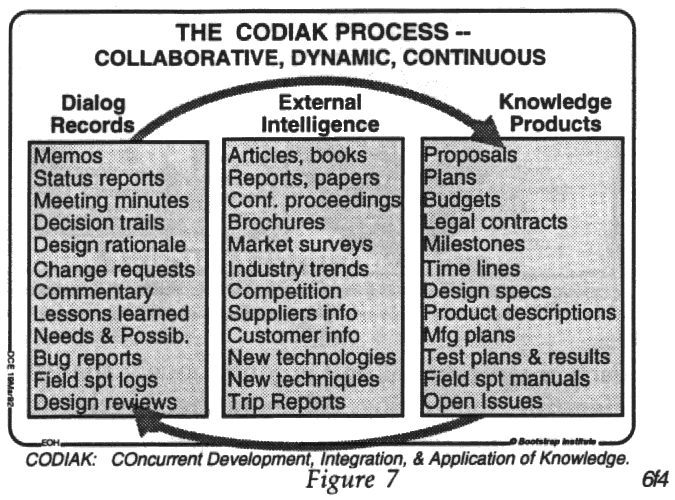
From Doug Engelbart's "Toward High-Performance Organizations: A Strategic Role for Groupware", see Blog50: Traction Roots - Doug Engelbart
4) The evolving blog, wiki, IM, syndication (RSS) and search infrastructure proves that it's possible for anyone to find and stay informed about what matters to them across a network as large and chaotic as the World Wide Web. I can get notified in minutes when a news source or blogger talks about my company. Why should the largest enterprises settle for less? I don't think they will.
The expectations everyone gets from finding what they want and staying informed on the public internet will drive people in business to ask why they can't know what's happening in their own enterprise.
I believe that within the next five years the communication pattern we're discussing will become the norm for business groups of all sizes, displacing broadcast email for dissemination, working communication and collaboration.
For annotated screenshots from my five minute demo (9.
 I18N ERROR: @tsiskin#footer_RSS_Feed